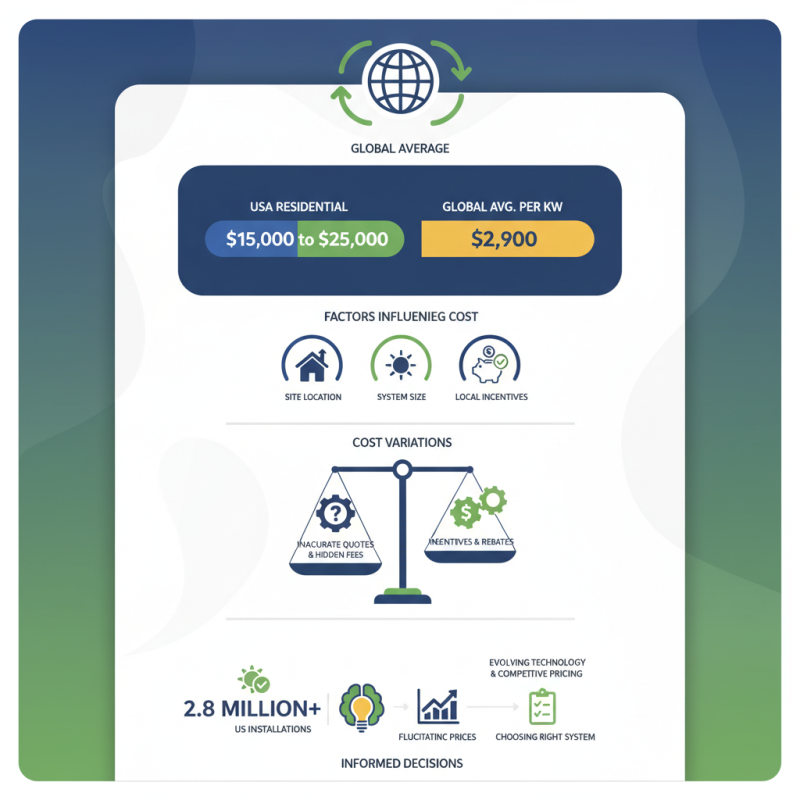
As the world shifts towards sustainable energy solutions, the question arises: how much does it cost to install a solar system? Recent studies reveal that the average cost of solar installation varies significantly across regions. In the United States, homeowners can expect to pay between $15,000 to $25,000 for a residential solar system. Meanwhile, the global average hovers around $2,900 per installed kilowatt, according to the International Renewable Energy Agency.
The factors influencing installation costs include site location, system size, and local incentives. In some countries, financial incentives and rebates can significantly offset costs, making solar more accessible. However, inaccuracies in quotes and differences in company pricing often lead to confusion. Consumers may find themselves reflecting on unexpected expenses or hidden fees during the installation process.
Understanding the cost dynamics is essential for informed decisions. With more than 2.8 million solar installations in the U.S. alone, many stakeholders emphasize the importance of evolving technology and competitive pricing. Yet, as we see fluctuating prices, potential adopters must weigh their options carefully, ensuring they choose the right systems for their needs.
Global Overview of Solar System Installation Costs
The cost of installing a solar system can vary widely around the globe. In the United States, the average cost per watt is about $3.50. This translates to approximately $15,000 for a typical residential system. However, prices may be lower in countries like India or China, where costs can drop to $1 per watt. Local labor costs and governmental incentives play a significant role in these numbers.
Installation costs are not just about hardware. They include permits, inspections, and interconnection fees. These additional elements can add significant expenses. Some regions experience logistical delays, which can inflate prices unexpectedly. Understanding regional differences is essential for accurate planning.
Not all installations yield immediate savings. Sometimes, lack of awareness about maintenance and long-term efficiency can lead to poor investments. Educating consumers on realistic expectations should be a priority. This knowledge gap often results in missed opportunities and financial strain. Assessing the true cost requires digging deeper than just initial pricing.
Global Solar System Installation Costs Overview
Average Costs of Solar Panel Systems by Region
The costs of installing solar systems vary significantly around the globe. In North America,
average installation costs are around $3.50 per watt,
translating to about $15,000 for a typical residential system.
In contrast, European nations tend to boast lower average costs. Reports indicate that countries like
Germany offer installations at approximately $2.50 per watt.
The declining costs in Europe reflect advancements in technology and economies of scale.
In Asia, the cost landscape is quite diverse. China, as a solar technology leader, sees average prices
of just $2.00 per watt. This allows higher adoption rates among homeowners.
However, in regions like India, where the average cost is about $2.80 per watt,
many households still grapple with financing options. These variations emphasize the need for
localized market analyses.
Local policies and incentives also influence solar costs across different regions. Some countries
offer subsidies that significantly reduce upfront costs. However, inconsistent regulations can lead
to confusion and slow the adoption of solar technology. Understanding these factors is crucial for
potential buyers. Transparency in pricing and financing options remains
a challenge in many markets. Without clear information, decision-makers often feel uncertain about their
investments in solar energy.
Factors Influencing Solar Installation Prices Worldwide
When considering the cost of solar system installation globally, several factors come into play. Local regulations impact pricing. Some regions offer incentives, while others have strict guidelines. The complexity of installation also varies. Rooftop setups may differ greatly from ground-mounted systems. Geographical location is crucial. Sunshine availability influences the effectiveness and size of the system needed.
Labor costs fluctuate significantly. In areas with high unemployment, you might find lower prices. Specialized skills are necessary for installation, affecting costs as well. Material quality is another key factor. While cheaper components may save money upfront, they often lead to higher long-term expenses due to lower efficiency.
Tips: Research local incentives before starting your project. Understanding available subsidies can dramatically reduce costs. Also, consider hiring local professionals. They know the regulations and can navigate permits more easily. Take time to check reviews and past projects. A reliable installer can make a significant difference in the overall success of your solar investment.
Cost Comparison: Solar Energy vs. Conventional Energy Sources
The cost of solar energy installation has become increasingly competitive compared to conventional energy sources. According to the International Renewable Energy Agency (IRENA), the global weighted average cost for solar photovoltaics dropped about 82% from 2010 to 2019. In contrast, coal power costs remained relatively stable, illustrating the shift toward renewable energy. By 2022, solar energy was often cheaper than fossil fuels in many regions.
Analyzing costs reveals that solar installations may require a higher initial investment. However, the operational costs are significantly lower over time. Reports indicate that the levelized cost of electricity (LCOE) for solar can be as low as $40 per megawatt-hour in optimal conditions. In contrast, fossil fuel-based electricity ranges from $50 to $150 per megawatt-hour.
Tip: When considering solar, evaluate your local utility rates. They greatly influence your overall savings. Additionally, check for available government incentives to further reduce upfront costs. This holistic approach may help you make a more informed decision.
Solar is not just a trend; it's a long-term solution. However, the transition may provoke challenges. Resilience planning and robust energy storage become necessary as reliance on variable sources increases.
Financial Incentives and Subsidies for Solar Installations Globally
Financial incentives and subsidies for solar installations are crucial in promoting renewable energy. Many countries offer various programs to reduce the upfront costs of solar systems. These incentives can come in the form of tax credits, rebates, or grants. For example, some governments provide direct financial assistance for residential installations. Even small-scale commercial projects can benefit similarly.
In addition to government support, local initiatives also play a role. Certain regions have established programs targeting specific demographics. These may include financial aid for low-income households to access solar energy. However, navigating these options can be overwhelming. Not all programs are available everywhere. Awareness and access to information remain challenges for potential solar adopters. Some regions may lack sufficient outreach.
While the financial benefits are clear, the installation costs may still be significant. Price variations exist depending on location, system size, and technology used. Not everyone knows how to maximize available incentives. Additionally, the landscape of financial incentives is constantly evolving. Policy changes can abruptly impact the attractiveness of solar projects. Educating oneself about the local landscape is essential for making informed decisions.
FAQS
: Local regulations, labor costs, material quality, and installation complexity significantly influence solar panel prices.
Costs differ worldwide, with North America averaging $3.50 per watt and Asia seeing prices as low as $2.00 per watt.
Yes, many regions offer subsidies that can reduce upfront costs. Research local options to maximize savings.
Solar’s operational costs are typically lower over time, despite higher initial investments compared to fossil fuels.
Sunshine availability affects how much energy solar systems can generate. This impacts system size and efficiency.
Look for local professionals with good reviews. Their knowledge of local regulations can make installation easier.
Without clear pricing, potential buyers may feel uncertain about their investments and miss out on better options.
Solar costs have dropped significantly, often making it cheaper than fossil fuels in many regions as of 2022.
Transitioning may lead to challenges like planning for resilience and ensuring adequate energy storage.
Yes, local utility rates greatly influence potential savings and overall costs for solar energy.
Conclusion
The article "How Much Does It Cost to Install a Solar System Globally?" provides a comprehensive analysis of the expenses associated with solar panel installations across various regions. It begins with a global overview of installation costs, highlighting significant variations influenced by local market conditions and resource availability. The average costs of solar panel systems are dissected by region, showcasing how geographical factors can lead to differing price points.
Furthermore, the article delves into the various factors that influence solar installation prices worldwide, such as technology advancements, labor costs, and government policies. A comparison of solar energy costs versus conventional energy sources is presented, emphasizing the financial benefits of solar systems in the long term. Finally, the discussion includes financial incentives and subsidies available globally, which can significantly reduce the initial investment. Overall, the article effectively answers the question of how much does it cost to install a solar system by illustrating the complexities and variables at play in the solar market.

 Zenvyra