Choosing the right solar system begins with one practical question: what size solar system do i need for my house? The answer is rarely found by measuring your roof alone. It starts with twelve months of electricity bills, your utility rate, and your home’s daily habits. A family using 900 kilowatt-hours monthly needs a different design from a smaller home using 450. Electric heating, an upcoming heat pump, an electric vehicle, and a pool can change the calculation quickly.
Solar educator and author Bill Nussey offers a useful principle: “Your solar system should be sized to match your energy consumption, not your roof alone.” That advice keeps the process grounded. A professional installer should review roof direction, shade from nearby trees, local weather, panel efficiency, inverter limits, and expected system degradation. Battery storage adds another decision. It can support evening use, but it does not automatically make an oversized system economical.
Real homes are less tidy than spreadsheets. A tree may shade one roof section after 3 p.m. Your summer bill may look unusually high. Your future plans may be unclear. That uncertainty matters. In 2026, a reliable estimate should compare annual production with actual consumption, then test several system sizes. It should also explain assumptions, not hide them. No calculator is perfect. A careful design leaves room for inspection, updated bills, and honest questions before contracts are signed.
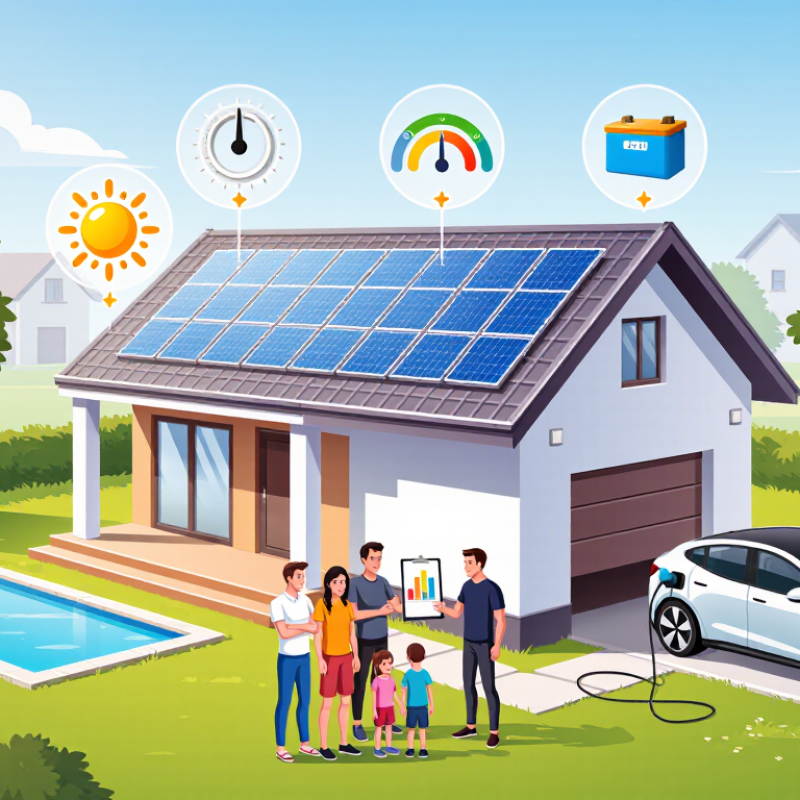
How to Calculate Your Home Solar System Size in 2026
Assessing electricity consumption is the most reliable starting point for solar sizing. Review 12 months of utility bills, not one recent statement. Seasonal use can shift sharply when air conditioning, heating, or electric water heating operates. The U.S. Energy Information Administration reported average residential electricity use of about 886 kilowatt-hours per month in its 2020 Residential Energy Consumption Survey. Your household may differ considerably.
Record each month’s kilowatt-hours and calculate the annual total. Then divide by 365 to find average daily demand. For example, 10,800 annual kilowatt-hours equals nearly 29.6 kilowatt-hours per day. A home using this much power might need roughly 7 to 9 kilowatts of solar capacity, depending on local sunlight, roof direction, shading, and system losses. The National Renewable Energy Laboratory’s PVWatts documentation accounts for losses from wiring, equipment, mismatch, and soiling. Ignore these factors, and the estimate becomes optimistic.
Look beyond total consumption. Identify high-use appliances with a plug-in meter or smart monitor. A 4,500-watt electric heater can distort winter bills quickly. Future changes matter too, such as an electric vehicle or heat pump. I would not size from an annual average alone. That method hides difficult months. Check the highest seasonal demand, compare it with local solar production data, and leave room for uncertainty. Your first estimate may be wrong. That is useful. Recalculate it.
| Appliance or Load | Typical Rated Power (W) | Estimated Use per Day (Hours) | Estimated Daily Energy (kWh) | Estimated Annual Energy (kWh) | Calculation Basis |
|---|---|---|---|---|---|
| Refrigerator | 150 | 10.0 | 1.50 | 547.50 | 150 W × 10 h ÷ 1,000 |
| LED Lighting | 60 | 5.0 | 0.30 | 109.50 | Combined lighting load |
| Air Conditioner | 1,500 | 4.0 | 6.00 | 2,190.00 | Average operating-equivalent time |
| Electric Water Heater | 3,000 | 1.5 | 4.50 | 1,642.50 | Heating element operating time |
| Clothes Washer | 500 | 0.5 | 0.25 | 91.25 | Average daily equivalent use |
| Dishwasher | 1,200 | 0.5 | 0.60 | 219.00 | Average daily equivalent use |
| Television and Media Equipment | 100 | 4.0 | 0.40 | 146.00 | Combined operating load |
| Computer and Home Office Equipment | 150 | 6.0 | 0.90 | 328.50 | Average operating load |
| Electric Cooking Appliances | 1,800 | 1.0 | 1.80 | 657.00 | Combined daily equivalent use |
| Other Plug Loads | 300 | 3.0 | 0.90 | 328.50 | Small appliances and standby loads |
| Total Estimated Consumption | — | — | 17.15 | 6,259.75 | Sum of estimated appliance energy use |
| Average Monthly Consumption | — | — | — | 521.65 | 6,259.75 kWh ÷ 12 months |
| Design Solar Resource | — | 4.5 | — | — | Assumed average peak sun hours per day |
| System Performance Factor | — | 80% | — | — | Allowance for inverter, wiring, temperature, and soiling losses |
| Estimated Required Solar Array Size | — | — | — | 4.77 kW | 6,259.75 ÷ (365 × 4.5 × 0.80) |
| Practical Recommended Array Size | — | — | — | Approximately 5.0 kW | Rounded up to provide a practical design margin |
Observe the roof from morning through late afternoon. Record shadows from trees, chimneys, walls, and nearby buildings. One clear day misleads. Check shading during winter, spring, summer, and autumn. A solar path app or light meter can improve estimates, but neither is perfect.
Measure each roof section’s length and width. Subtract skylights, vents, roof edges, and maintenance pathways. Measure usable space. Record roof direction and slope with a simple sketch and photographs. Small measurement errors can reduce the final panel layout.
Review at least twelve months of electricity bills. Add the monthly kilowatt-hours, then divide by the billing days. For example, 900 kWh over thirty days equals approximately 30 kWh daily. Avoid using one unusually low bill.
Divide daily electricity use by local peak sunlight hours and the expected system efficiency. A practical planning factor is usually 0.75 to 0.85. For example, 30 kWh daily, 4.5 sunlight hours, and 80% efficiency require about 8.3 kW. This remains an estimate.
Heat, dust, wiring, inverter conversion, shading, clouds, and snow reduce production. Panels rarely operate at their rated output throughout the day. Losses matter. Using an 80% performance factor gives a more realistic planning result than assuming perfect production.
A home using 9,000 kWh yearly, with 4.5 peak-sun hours, needs about 5.5 kW before losses. The calculation is 9,000 divided by 4.5 times 365. Applying an 80% factor increases the estimate to roughly 6.9 kW.
Check the weakest production month, not only the yearly average. A home using 35 kWh daily with 3.2 peak-sun hours may need nearly 13.7 kW at 80% efficiency. That could produce excess summer electricity. Cloudy weeks complicate the estimate.
Divide the required system capacity by each panel’s wattage. Twenty-one 400-watt panels provide approximately 8.4 kW. Roof space still decides feasibility. Leave safe access routes, and consider future loads such as an electric vehicle or heat pump. Oversizing may increase costs without improving savings.
A qualified professional should check structural strength, electrical limits, wiring routes, fire access, permits, and utility requirements. My calculation is only a planning estimate. It may be wrong. Pause when roof measurements, bills, and production estimates conflict.
Determining the right home solar system begins with reviewing your recent electricity bills to understand average daily and monthly energy use. Next, evaluate the sunlight available at your property, including roof orientation, shading, usable roof area, and seasonal differences. These factors help estimate how much solar energy your home can produce and whether the available space can support the required number of panels.
To answer the question “what size solar system do i need for my house,” convert your energy demand into the required solar panel capacity using local sunlight conditions. Then account for normal system losses caused by wiring, temperature, dust, inverter conversion, and changing weather. Finally, select an appropriately sized inverter and decide whether battery storage is necessary for backup power or greater energy independence. A final system size should balance household consumption, roof conditions, future energy needs, budget, and local installation requirements.

 Zenvyra